One plate. Seven foods, each with its grams.
- Read. Google’s Gemini names each food on the plate and estimates its grams. Take up to three photos from different sides, and they are read together.
- Matched. Each food is matched to a row of AUSNUT 2023, Australia’s food database. Every number comes from that row, never from the model.
- Added up. This plate came to 176 calories. Every figure is traced below.
Not one nutrient figure is invented.
A model names the food and guesses the grams. A database supplies every number.
The model
Gemini reads the plate
- Names each food it can see
- Estimates how many grams of each
- Says how sure it is, food by food
Estimates
The database
AUSNUT 2023 supplies the figures
- Every calorie and kilojoule
- Every gram of protein, carbohydrate and fat
- Every vitamin and mineral
Published values
- Foods in the database
- 3,741
- Nutrient figures held for every one of them
- 58
- Household measures, so “one cup” has a weight
- 6,207
No gaps: all 58 figures are present for all 3,741 foods.
Every number on that plate, and where it came from.
The record behind the fruit plate above, row by row. The source row is named on every food in the app too, so anyone can check it.
Swipe the table sideways for the figures.
| Food, as identified | Amount | Matched to AUSNUT | kJ / 100 g | Energy | Prot | Carb | Fat |
|---|---|---|---|---|---|---|---|
| Dragon fruit | 90 g | F009872 Dragon fruit, peeled, raw | 230 | 207.0 | 1.2 | 8.7 | 0.7 |
| Passionfruit pulp | 35 g | F006333 Passionfruit, raw | 331 | 115.8 | 1.0 | 2.4 | 0.5 |
| Strawberries | 75 g | F008952 Strawberry, raw | 132 | 99.0 | 0.5 | 4.2 | 0.2 |
| Green grapes | 55 g | F004260 Grape, green, seedless, raw | 277 | 152.4 | 0.4 | 8.7 | 0.0 |
| Rockmelon and mango | 70 g | F004154 Fruit salad, fresh, commercial | 164 | 114.8 | 0.4 | 5.8 | 0.1 |
| Blueberries | 15 g | F001290 Blueberry, raw | 203 | 30.4 | 0.1 | 1.6 | 0.0 |
| Lime wedge | 15 g | F005199 Lime, peeled, raw | 117 | 17.6 | 0.1 | 0.2 | 0.0 |
| The plate | 355 g | seven rows of AUSNUT 2023 | 737 kJ | 3.7 | 32 | 1.4 |
Where the energy came from
- Dragon fruit 207.0 kJ · 28%
- Green grapes 152.4 kJ · 21%
- Passionfruit pulp 115.8 kJ · 16%
- Rockmelon and mango 114.8 kJ · 16%
- Strawberries 99.0 kJ · 13%
- Blueberries 30.4 kJ · 4%
- Lime wedge 17.6 kJ · 2%
It keeps the range, not just the guess.
Every guess keeps its range. Of the foods it is unsure about, it asks you to check the one carrying the most energy, because that one can move the total most. On this plate, the dragon fruit.
-
Dragon fruit 90 g (68 to 123)
High confidence · a 55 g spread · the one it asks about
-
Passionfruit pulp 35 g (24 to 52)
High confidence · a 28 g spread
-
Strawberries 75 g (53 to 108)
High confidence · a 55 g spread
-
Green grapes 55 g (38 to 77)
High confidence · a 38 g spread
-
Rockmelon and mango 70 g (42 to 103)
Medium confidence · a 60 g spread
-
Blueberries 15 g (10 to 26)
High confidence · a 16 g spread
-
Lime wedge 15 g (10 to 20)
High confidence · a 11 g spread
Why Gemini reads the photos. We tested before we chose.
The model that guesses the grams is the one choice that moves every number after it. So we measured six of them against a scale, with the rules written down before the first photo was sent.
The truth
300 plates, on a scale
Nutrition5k, published by Google Research: real cafeteria plates, every ingredient put on a scale before the photo was taken. Each model's grams were scored against the scale.
Round one
Six models, 30 plates
Two Gemini models, three Claude models and GPT-6, each given the same photos and Plategist’s own instructions. 360 readings, none failed. The three closest to the scale went on.
Round two
Three models, all 300
Gemini 3.8 Flash was as close to the scale as the larger Gemini 3.1 Pro on the same plates, for well under half the cost a photo, and its ranges held the true weight more often. Claude Sonnet 5 came out about 6 points further away.
- Photo readings across every test
- 2,470
- Models compared, from three companies
- 6
- Typical gap from the scale, plate total, Gemini 3.8 Flash
- 21%
- Plates where the true weight sat inside the app’s range, 300 new plates, 19 Oct
- 68%
Tested again, 19 October
300 new plates. The result was lower.
After the first test we widened the app’s estimated range a little, and scored it on the same 300 plates: 79%. A test scored on the plates it was tuned on flatters itself, so we ran the app as it is now on 300 Nutrition5k plates it had never seen.
| Measure | First test, 5 Oct | Re-test, 19 Oct |
|---|---|---|
| Plates | 300 | 300, none used before |
| True weight inside the app’s range | 74% | 68% |
With 300 plates, either figure could be about 5 points either way. When the weight fell outside the range, the app had guessed too heavy on 43 plates and too light on 53, so it does not lean one way. We are finding out why the new plates came out lower, and will put what we find here.
What else we tested
- Extra photos from the side. On the same 100 plates, two side views made no measurable difference to the grams. What they help with is seeing food hidden behind other food, which is why you can take up to three.
- Telling it about big serves. An extra instruction about large portions changed nothing that mattered, so it was left out.
- How the food is matched. On 82 plates we compared the energy per gram our matching found in AUSNUT with Nutrition5k’s own figures. Typically 25% apart, partly because those are American cafeteria foods and AUSNUT describes Australian ones.
- Mix-ups. On 19 plates where it named a food wrongly, “Could also be” and “Look again” together put the right food in front of you on 16.
What the numbers mean
A photo is not a scale. In this test, a typical plate was about a fifth off, and some were much further. No model we tried got portions right every time; recent studies of frontier models find the same. That is why Plategist flags the amount it is least sure of with “Check this amount”, and lets you put in the amount from your own scale whenever you have one. When a new model appears, we run the same test again before changing anything.
Tested 5 to 7 October 2026, and again on 19 October on 300 plates not used before. Nutrition5k: Thames et al., CVPR 2021, used under CC BY 4.0. Google Research does not endorse Plategist.
A portion judged from a photo is a guess.
So it says so. Nudge any amount, swap a food for what it really was, or repeat a meal in one tap.
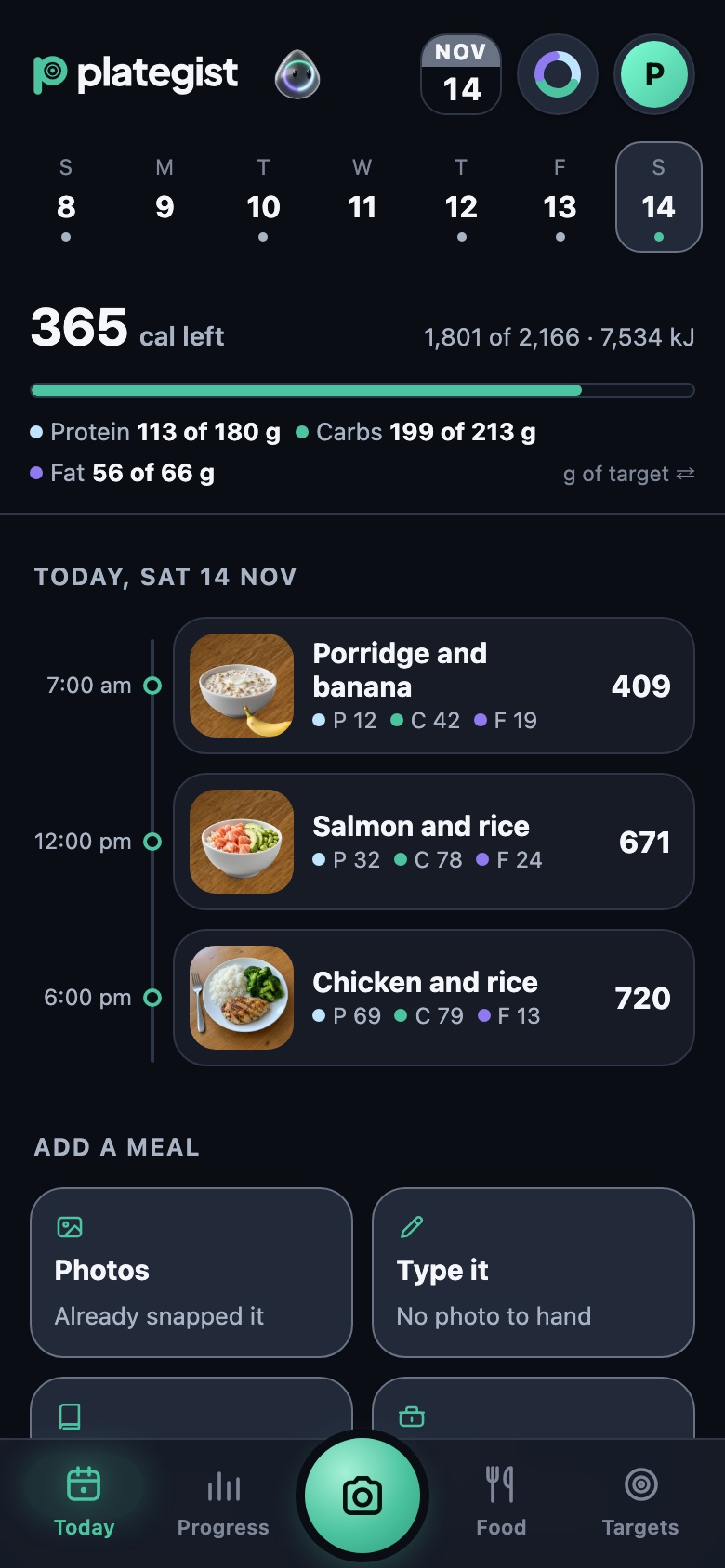
Photograph it, type it, or scan the packet.
One photo, or up to three from different sides. Or type it in plain words. Or photograph the panel on a packet, and the label is read.
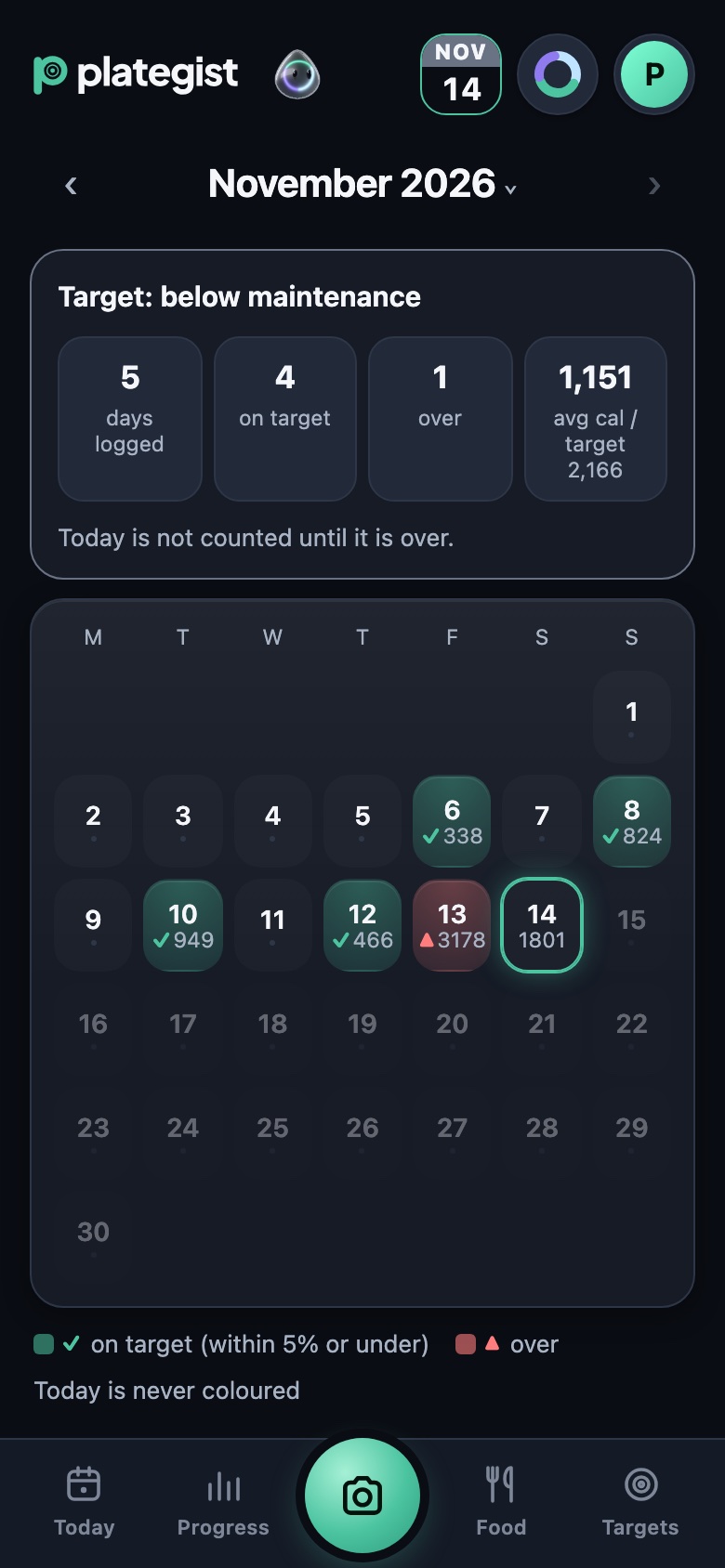
One meal is a guide. A week is the signal.
Your week, month and year against targets by grams, percentage or calories. A missed day is a gap, not a zero. A smoothed weight trend, and reminders at your usual meal times, never what to eat.
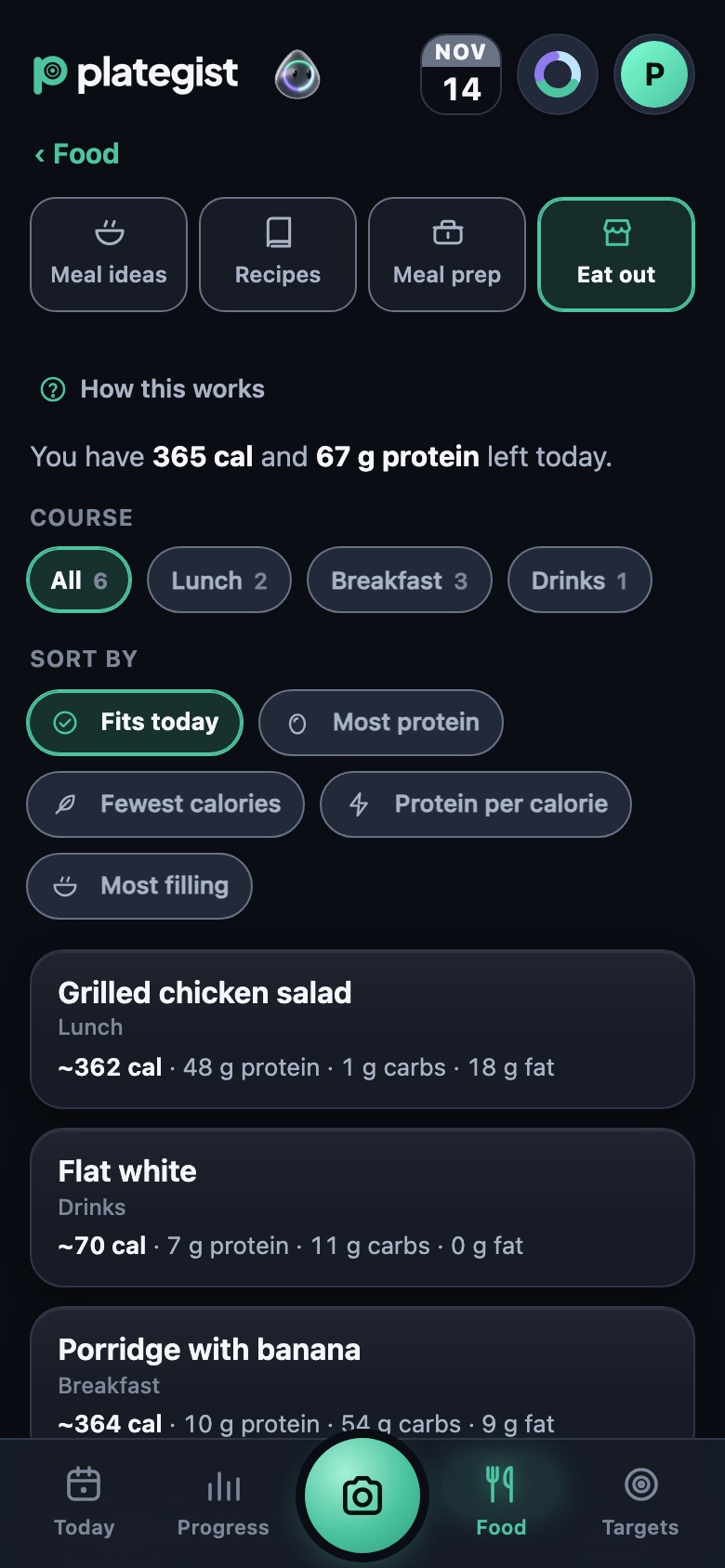
Read the menu before you order.
Photograph a menu. See what each dish comes to, and which fit what is left of your day.
Recipes, ideas and meal prep.
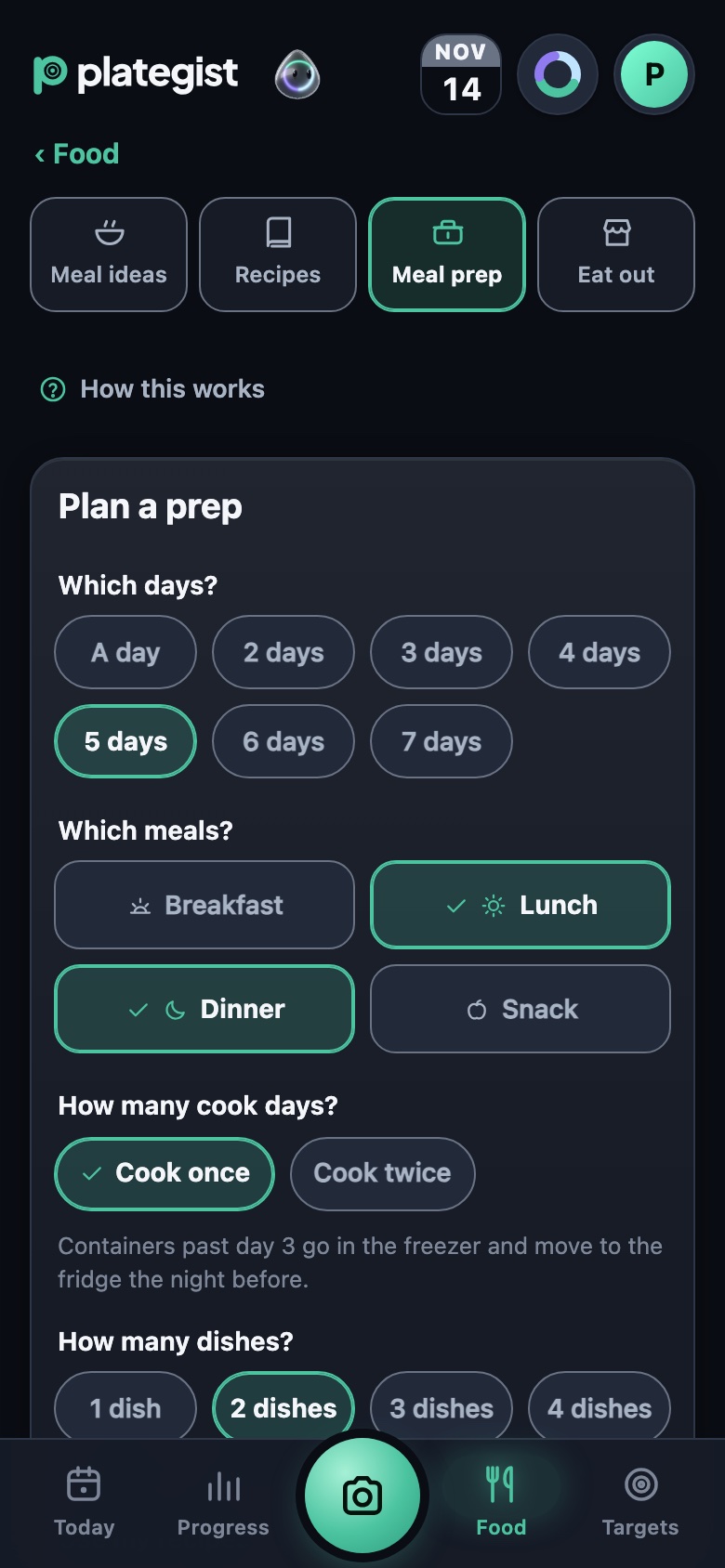
Save your own recipes and log them by the serve. Ask for an idea that fits what is left today, or plan a few days of prep with a cook list and a shopping list. The numbers come from AUSNUT, never the AI.
Built the way we’d want our own food diary built.
No passwords
Your face or fingerprint. Nothing to leak.
Stored in Sydney
Your log is stored in Sydney, with encrypted backups gone after 30 days. Photos are read by Google’s Gemini.
Yours to take and delete
Export your log any time. Delete your account, and it is gone.
Photos are optional
Keep them or don't. The log works the same, and a photo you don't keep is deleted from our server once it is read.
Australian food data
A flat white is a flat white.
No ads, no feed
A diary, not a social network.
Start with fourteen days.
Fourteen days free, no card to start. Sign up with your email or Google. See pricing.
Start your free trialAustralia only for now. Outside Australia? Join the list for your country.
No form here. The website counts visits with Google Analytics; the app does not. Privacy policy.
What Plategist is not
- It estimates, it does not measure. One meal is a guide; a week is the signal.
- Not medical, dietary or nutritional advice, and not a medical device.
- Do not rely on it where being wrong matters medically: insulin, allergies or intolerances, a prescribed diet, an eating disorder, pregnancy, or feeding a child. See a doctor or an accredited practising dietitian.
- It cannot tell you whether a food contains an allergen.
- Figures describe typical foods, not your exact product or how it was made.